
CASE STUDY
Legal Animation
Turn complex facts into clear, courtroom-ready visual evidence that supports testimony and keeps jurors oriented.
Turning Complex Evidence Into Courtroom-Ready Clarity.
How Legal Animation turns hundreds of pages of records, testimony and expert analysis into trial-ready visual evidence that keeps jurors oriented from mediation to verdict.
Project overview
Visual Evidence That Supports Testimony And Keeps Jurors Oriented.
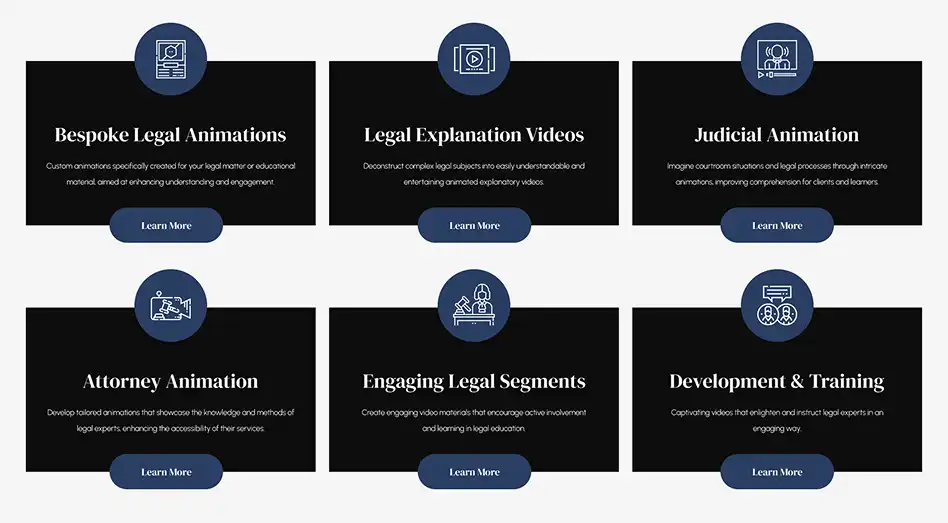
Legal Animation creates litigation visuals forensic animation, courtroom graphics, 3D models and medical animations built from the record and expert input.
Attorneys face a common challenge: critical facts are buried across emails, reports, photos and depositions. The goal was to transform complex evidence into clear, courtroom-ready visuals that explain sequence, causation and damages.
Every frame had to be designed for one thing above all: clarity, accuracy and credibility that survive challenge from opposing counsel.

The Challenge
Jurors Are Not Case Managers.
Jurors are everyday people hearing unfamiliar concepts in a formal setting, with limited time. Even strong testimony can lose its impact when it is hard to visualize disputed timing, contested movement and visibility, or an injury mechanism that anatomy alone cannot explain.
The harder problem was credibility. It is easy to make a persuasive video; it is difficult to make one that holds up when the other side asks what it is based on. The work had to increase comprehension and clarify complex testimony without ever overstating what the record could prove.
The harder problem was credibility. It is easy to make a persuasive video; it is difficult to make one that holds up when the other side asks what it is based on. The work had to increase comprehension and clarify complex testimony without ever overstating what the record could prove.
Design Thinking
A Documentation-First Workflow.
The build process matters as much as the final design. To support admissibility and reduce motion practice, every project runs on a workflow litigators recognize immediately.
01
02
03
Approach
Living Up To Contemporary Standards.
If an animation cannot be explained, sourced and defended, it should not exist. Every motion, distance, timing cue and viewpoint is traceable to evidence, expert input or a clearly stated assumption.
That discipline runs through a five-stage production process — the difference between a nice video and forensic animation that performs in depositions, mediation and trial.
That discipline runs through a five-stage production process — the difference between a nice video and forensic animation that performs in depositions, mediation and trial.

01
02
03
04
05
Design Thinking
Communicating The Brand To The Masses
Jurors decide on what they understand, what they trust, and what feels consistent. Across every scene model, medical sequence and timeline, the work gives the record a structure — helping the courtroom see the sequence, understand complex data, and stay anchored during testimony.


Outcome
An Intuitive Design Experience.
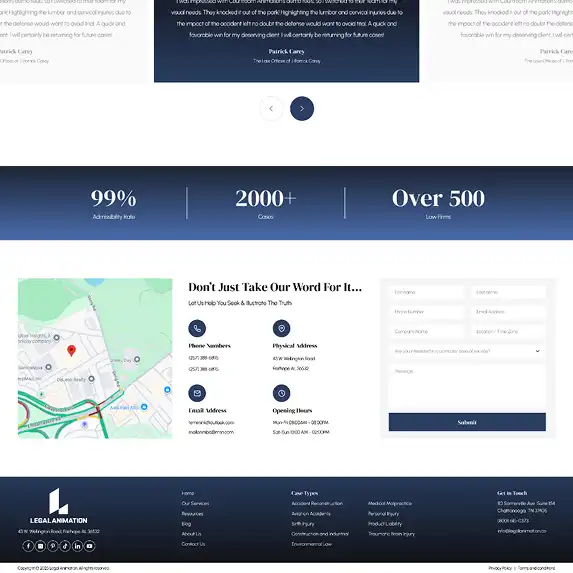
98%
Admissibility Rate
|
$500K
Policy-Limit Settlement Secured
|
Faster
Mediation & Resolution
|
Fewer
Hours Spent Explaining Basics
Outcome That Inspires
High-quality visuals paid for themselves by shortening the path to resolution. When a brutal pitbull attack left an elderly man severely injured, forensic animation made the sequence undeniable helping counsel secure a $500,000 policy-limits settlement before trial.
Clear visuals strengthened settlement posture, cut the trial time spent untangling confusion, and removed the doubt that comes from complexity rather than the facts. That is the real return: measurable clarity that changes how a case is understood.
Clear visuals strengthened settlement posture, cut the trial time spent untangling confusion, and removed the doubt that comes from complexity rather than the facts. That is the real return: measurable clarity that changes how a case is understood.